How every transformational technology company is just peanut butter meeting chocolate — and why the human need always outlasts the delivery vehicle.
We got together and started this company to solve accute problems arrising from living with vision imparements. Its a tall order, but we've got the team to do it. I've spent a career at the intersection of technology and human need — building infrastructure companies, immersive media systems, financial engines, all based on turning data into vision. While we cannot solve any medical causes of VI, my career has taught me that solving pain associated with even a little bit of the problem is better than solving none. With that in mind, we looked backwards in order to look ahead. How to structure this to do the most good, fastest, at the least expense and move that needle a little bit. How have companies in the past done it and what can we "borrow" from their value propositions.
I am, in the truest sense, a student of history. Not out of nostalgia — but because history is the only honest data set we have about what humans actually need when you strip away the fashion of the moment. And what history shows, without exception, is that the need is almost never new. The delivery vehicle is. Acknowledging this, we decided on a layered approach to the problem, as many successful commpanies do.
"What makes us human is our collective ability to improve our wholistic condition, and iterate on that continually. Technology is the fuel for that virtuous cycle. Just remember to turn it off when you leave the room."
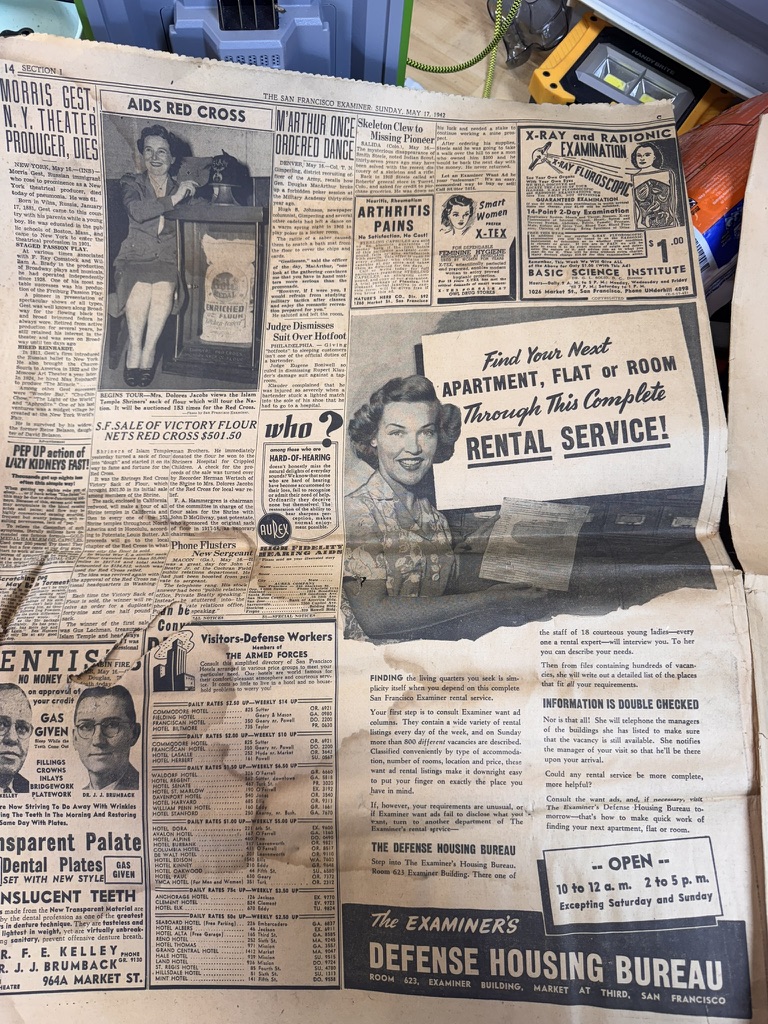
— Connolly Family ProverbSo, in the newspaper I referenced above from 1942, the Examiner ran an ad for Aurex hearing aids..85 years ago. "Hard of hearing?" it asked. "You honestly miss the natural delights of everyday sounds." Today, Oticon, Phonak, and Starkey say almost exactly the same thing — they've just swapped analog circuitry for machine learning and the mail-order form for an audiologist's iPad. The hearing aid industry is worth $10 billion. The need is identical to what it was 80 years ago.
The same paper ran the Examiner's Defense Housing Bureau — 18 "courteous young ladies" manually matching returning soldiers to available apartments. They checked vacancies by telephone, wrote descriptions by hand, and filed everything in physical folders. Today that operation is called Zillow. The folder is a database. The courteous young lady is an algorithm. The business — connecting people who need shelter with people who have it — has not changed one syllable.
Wearable technology, Social Networking, Peptides. Matchmaking, Full Body Scans, Ride Shares, Delivery Services. Every one of these is a multi-billion dollar industry today. None of these businesses have actually changed what they do. They changed how they do it. Thats what we're trying to do here. It's an age old problem with really outdated and ineffective solutions, and were going to change that.
In 1928, a Reese's Peanut Butter Cup was invented not by discovering something new, but by combining two things that already existed. Chocolate was old. Peanut butter was old. The genius was the combination — and the recognition that together they were worth more than the sum of their parts.
Every transformational technology company in the last 50 years is a Reese's cup.
Jerry Yang and David Filo did not invent the internet. HTTP existed. Web servers existed. What they did was put a directory service — a concept as old as the phone book — on top of a network of HTTP daemons. The directory was the peanut butter. The internet was the chocolate.
Sam Altman did not invent neural networks. The transformer architecture was published by Google in 2017. What OpenAI did was apply it to general human language interaction and put a clean chat interface in front of it. The transformer was the chocolate. The chat interface was the peanut butter.
Bill Gates did not invent the operating system. He put a graphical shell — borrowed from Xerox PARC — in front of MS-DOS and licensed it to IBM. The GUI was peanut butter. DOS was chocolate. The genius was seeing that people would pay for the combination.
The US military built GPS to guide missiles, then made it civilian. Apple put it in a phone. Uber put Uber on top of that. The taxi industry — structurally unchanged since the horse-drawn cab — collapsed in a decade. Three commodities. One combination.
The pattern repeats, endlessly: take something generic, combine it with something human, call it something new. Thats awesome, but, what most companies miss here is the whole "solving a problem" while doing something differently thing. A technological solution for something that is not a problem is, well, not a solution. Cue is 99% problem solve, 1% just really nice to have.
Sometimes the combination doesn't just create a company. It breaks something that took centuries to build.
A DJI Phantom costs $800. A block of C4 costs less. For under a thousand dollars, someone in a garage in 2015 rendered billion-dollar air defense systems partially obsolete, rewrote infantry tactics that hadn't changed since World War I, and forced every military on earth to rethink their doctrine. They didn't invent the drone. They didn't invent the explosive. They combined two commodities and broke warfare.
The DJI was built to take wedding photos. The C4 was built for demolition. Nobody at DJI's product meeting said “we are building a weapons delivery platform.” But the combination, once obvious, could not be unobvious (is that a word? dunno). Now it is a global industry, born from a short Special Military Operation.
An interesting way to look at innovations, is in collisions. Take the Great Reeses Collison of 1923 (the most powerful collision in history, IMHO) which seems obvious in hindsight but the long-term ramifications came tangentially in countless downlines. A more serious example is Gutenberg. Gutenberg's press didn't just print books — it ended the Church's information monopoly and triggered the Reformation. The shipping container didn't just move goods — it relocated manufacturing to wherever labor was cheapest and created a globalized, just-in-time supply chain. Social media wasn't built for revolution — but combined with suppressed populations, it became revolution infrastructure.
Collisions share one anatomy: a commodity technology that has just crossed a cost threshold, meeting a locked system that was built for a world where disruption was expensive. At the moment the commodity's cost curve crosses below the locked system's defense threshold, the incumbent has no answer. It was optimized for the old cost structure. It cannot un-optimize (pretty sure that one is a word) fast enough.
A multi-channel spectral sensor is a piece of boring laboratory equipment that has existed for decades. Near-infrared reflectance spectroscopy is not new. The desire to dress with dignity when your vision fails is not new — it is ancient, universal, and completely unsolved at scale.
When you combine the sensor with the need, you get something that has never existed before: a garment identity layer that works without light, without cameras, without barcodes, and without a caregiver in the room. A system that hears your wardrobe in your own voice. A device that every nursing home on earth will eventually want, that every parent leaving for college will send their child, that every ophthalmologist in the country will eventually recommend.
The 1942 Examiner ran an ad for hearing aids. In 2026, 1.1 billion people have vision impairment severe enough to affect daily life. That number reaches 1.8 billion by 2050. The problem has never been solved at the device level — because the sensor didn't exist at this price point, and the AI to classify what it reads didn't exist at this accuracy.
Now it does. That's the Reese's moment.
I've spent enough time studying history to know that this stuff is going to come around “again.” I mean, the Defense Housing Bureau of 1942 is Zillow. The X-ray company is 23 and me, the taxi company is Uber. Whether it is "I cant find cat videos" or "let's share a ride"...There is always a problem waiting for someone to care.
It's a convergence thing. Is the commodity technology cheap enough? Is the AI accurate enough? Is the human need acute enough? For CUE, in 2026, all three answers are yes — for the first time simultaneously. That is not a coincidence. That is a Reese's moment. Just my 2 cents.
And Reese's moments, historically, don't wait. Patrick
Full disclosure: Reese's Peanut Butter Cups are my all-time favorite snack. Make of that what you will.